Sending a follow-up email just after the first one was opened increases your reply rate by 80%.
Add the famous read receipt in your Gmail
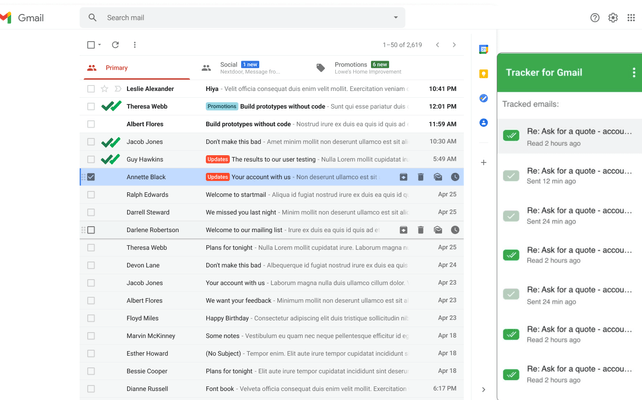





Receive an instant notification as soon as your email is opened
For each tracked email, get a list of all the time it was opened
Your privacy matters: we can’t read your emails. Learn more:
https://mailtrack.email/security
Companies and organizations from all over the world trust Mail Track for Gmail










See what your clients say about us
A cut above the rest of the email tracker for gmail software available. Super easy to use and a generous free plan. Plus, importantly, it doesn't request permission to read my emails.
One of the best email tracking to know when our important emails are opened.
Always know what you will pay
| Free | Premium | |
|---|---|---|
| $0$0 | $2.99$5.99 | |
| / month/ month | / user / month/ user / month | |
| Tracked emails per day | Unlimited | Unlimited |
| Track from mobile | ||
| Mail notifications | ||
| Remove Mail Track Branding | ||
| Real time notifications | ||
| Team Plan | ||
| Get startedGet started | Get startedGet started |
In the 20th century, the women's liberation movement and the civil rights movement challenged traditional relationship norms, advocating for greater equality, diversity, and inclusivity. The 1960s and 1970s saw a cultural explosion of free love, non-monogamy, and alternative relationships, which paved the way for contemporary discussions around consent, boundaries, and relationship diversity.
The Enlightenment and the Industrial Revolution brought significant changes to the way people perceived and experienced romantic relationships. The emergence of the nuclear family and the rise of individualism led to a greater emphasis on personal freedom, emotional intimacy, and companionate love. The 19th and 20th centuries saw the proliferation of romantic literature, film, and music, which helped shape modern notions of love and relationships. sasur+bahu+sex+mmsmobi+free
Relationships and romantic storylines have been an integral part of human experience and creative expression throughout history. From ancient myths and fairy tales to modern-day movies and television shows, the portrayal of romantic relationships has evolved significantly over time, reflecting changing societal values, cultural norms, and psychological insights. In the 20th century, the women's liberation movement
The Middle Ages saw the rise of courtly love, a literary and philosophical movement that idealized chivalry, honor, and adulterous love. The legend of Tristan and Isolde, for example, exemplifies the intense passion and self-sacrifice associated with courtly love. During this period, relationships were often characterized by a sense of longing and unrequited love, as expressed in the poetry of troubadours and Minnesingers. The emergence of the nuclear family and the
Relationships and romantic storylines are complex and multifaceted, reflecting the ever-changing landscape of human experience, cultural norms, and psychological insights. As we continue to navigate the intricacies of love, intimacy, and relationships, media representations will play a significant role in shaping our understanding of what it means to love, to be loved, and to build meaningful connections with others. By embracing diverse relationship models, challenging traditional norms, and promoting empathy and understanding, we can foster a more inclusive and compassionate understanding of the human experience.
Install our free mailtracker now
![[object Object]](https://umsousercontent.com/lib_SOghfaNrOBnPjwdM/xmb70q1hfmzey2nb.png?w=68)